HIGH INTENSITY UV SOURCES mW/cm² (milliwatts/square cm).

MODEL 5.0
Total UV (A+B) 280-400 nm, mW/cm² (milliwatts/square cm). Overall lamp intensity vs. ageing.

-------------------------------------------------

LOW INTENSITY UV FROM WINDOWS, REPTILE LAMPS AND STERILISATION LAMPS uW/cm² (microwatts/square cm).

MODEL 5.7
Total UV (A+B) 280-400 nm, uW/cm² (microwatts/square cm). Low level UV from windows & home lamps.

MODEL 6.2
UVB 280-320 nm, uW/cm² (microwatts/square cm). Low level UV reptile lamps.


MODEL 8.0
UVC 246-262 nm, uW/cm² (microwatts/square cm). Peak 254 nm. Germicidal lamps.

------------------------------------------------

SPECIALITY ENVIRONMENT APPLICATION – UV INDEX AND VITAMIN D3

MODEL 6.5
UV index outdoor solar intensity. International standard for UV Index. mWm2 Eeff/ 25.


MODEL 6.4
Vitamin D3 IU / minute. UVB synthesized International Units of 25(OH)D converted from 7-DHC.

----------------------------------------------

ERYTHEMALLY EFFECTIVE UVR

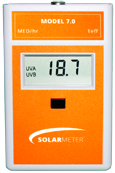
MODEL 7.0
MED/HR 280-400 nm SUV. Minimal Erythema Dose/Hour Diffey weighted irradiance.


MODEL 7.5
W/m2 Eeff(Ery) for new Australian Standard Solaria regulations of 0.9 W/m2.

------------------------------------------------

VISIBLE BLUE & RED LIGHT PHOTOTHERAPY LAMPS AND LED’s

SOLARMETER 7.0 MED/HOUR - ENQUIRE ON THIS PRODUCT

The Model 7.0 features an Integral Sensor and applications include MED/Hour, lamp/sun output, estimate exposure time, acrylic shield transmission, eyewear UV block comparison.

Specifications Radiometer
Model 7.0
Irradiance Range 0-199.9 MED/Hour
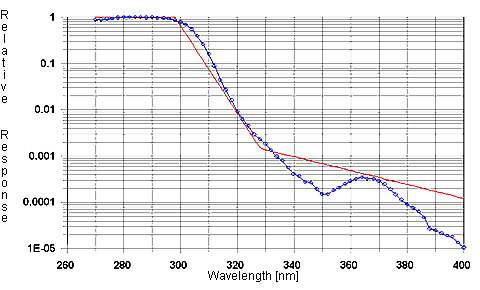
Response 280-400 nm Diffey EAS
Resolution 0.1 MED/Hour
Conversion Rate 3.0 Readings/Sec
Display 3.5 Digit LCD
Operating Temps 0° C to 40° C
Operating Humidity 5% to 80% RH
Accuracy ±10% REF.NIST
Dimensions (LxWxD) 10.5 x 6 x 2.2 cm
Weight 110 Grams
Power Source 9-Volt DC Battery
Lens UV Glass
Diffuser Virgin Teflon .005
Detector SIC/IF Photodiode

.

Sensor/Detector
Silicon Carbide (SIC) Photodiode packaged in hermetically sealed UV glass window cap with Interference filter coating (Metal Oxide).

Australian Standard: AS/NZS 2635:2008 - SOLARIA FOR COSMETIC PURPOSES
This standard is required reading by all Solaria operators to ensure they comply with the law. If you operate Solaria for Cosmetic Purposes we recommend you click on the link above and purchase a copy without delay. The need for this Standard arose from recognition that there was no standardisation or formal regulation of equipment performance and day-to-day procedures in the large number of commercial solarium establishments operating within Australia and New Zealand. The Standard was prepared with a view to acknowledging this need by establishing requirements for installing, maintaining and operating one or more sun-tanning units for the purpose of administering cosmetic tanning. Although the general import of the Standard suggests its application to commercial establishments only, some of the operational requirements set out in the Standard are equally applicable as a guide to the domestic use of sun-tanning units.

The requirements set out by this Standard are divided as follows: Section 2 sets out requirements for installing and maintaining sun-tanning units, and Section 3 sets out requirements covering the operation of sun-tanning units. Section 3 includes requirements for the content of warning notices and client consent forms.

Endorsement of intentional exposure to ultraviolet radiation is not the object of this Standard. However, the Standard does acknowledge the continuing popularity of suntanning unit use and sets out requirements which, if complied with, establish a safer situation than that which accompanies uncontrolled cosmetic tanning practices.

Maximum Initial Exposure
Time for the initial sun-tanning exposure shall not exceed time Ti (in minutes) as determined from the following equation.

Ti =

0.5 x MED
UVReff X 60

The MEDk is:
Skin Type II = 250 J/m2
Skin Type III = 350 J/m2
Skin Type IV = 450 J/m2
Skin Type V = 450 J/m2
Skin Type VI = 450 J/m2

Maximum Repeated Exposure
Any single exposure in a sun-tanning unit should not exceed 0.9 MED.

Maximum Weekly Exposure
Repeated sun-tanning exposure shall not exceed 3 MED per week irrespective of the
exposure schedule. Repeated exposure shall be administered no sooner than 48 hours after the previous exposure including initial exposure.

Maximum Exposure Schedules
If you operate sunbeds in a commercial environment in Australia or New Zealand and would like information on our Solaria Exposure Guide, including our recommended meters, please contact us for more information.

Proper Usage of Solarmeter ® Ultraviolet Radiometer for Lamp Tests

  • Wear UV-block eye protection when checking UV lamps

  • Allow lamps to warm-up prior to taking readings (at least 5 min)

  • Hold sensor close to lamp or acrylic to measure individual lamp MED intensity. Hold sensor at 25cm above bench acrylic with canopy closed (approx body position), for overall canopy measurement

  • Press and hold push-button switch on face of unit. Aim sensor window in top panel of meter directly at UV source

  • Note reading on LCD and record for use with our Excel Spreadsheet Utility supplied with all Model 7.0 MED/Hour meters

ENQUIRE ON THIS PRODUCT

BACK TO TOP